
Would you spend $230 on top of an already good handbrake just to change how it feels in your hand? That’s the real question at the center of our SimNet SHB-100 review, and it’s more complicated than a simple yes or no.
Dave Adams put the SHB-100 through its paces in two configurations: stock, and upgraded with SimNet’s Hydro-Link Pro Kit. The result is one of the more interesting hardware reviews we’ve run in a while. Dave’s conclusion isn’t “buy this” or “skip this.” It’s “here’s exactly who this is for, and who it isn’t.”
What you’re getting for $130
Before the hydraulics enter the conversation, the base SHB-100 is worth understanding on its own. At $129.99, here’s what you’re working with:
- 12-bit, 100kg load cell sensor for accurate pressure reading (not a simple on/off switch)
- 3mm stainless steel body combined with machined aluminum for rigidity
- Lever runs on free float bearings, fully adjustable with the optional extension kit
- Mountable vertically or horizontally
- Mechanical resistance tuning via included springs and elastomers
- Full software control over usable range, dead zone, response curve, and filtering through SimNet’s Sim Connect Manager
Dave’s take: if this were the only version he tested, he’d call it a very solid load cell handbrake and move on with his life. The Hydro-Link kit is what changes the conversation entirely.
What the Hydro-Link Pro Kit changes
This is the part worth slowing down on. It’s easy to misunderstand what you’re actually paying for here. The Hydro-Link kit doesn’t change what data gets sent to your sim. Your inputs are read exactly the same way. What it replaces is the mechanism generating the resistance. Instead of springs and elastomers, you’re pulling through an actual master and slave cylinder assembly.
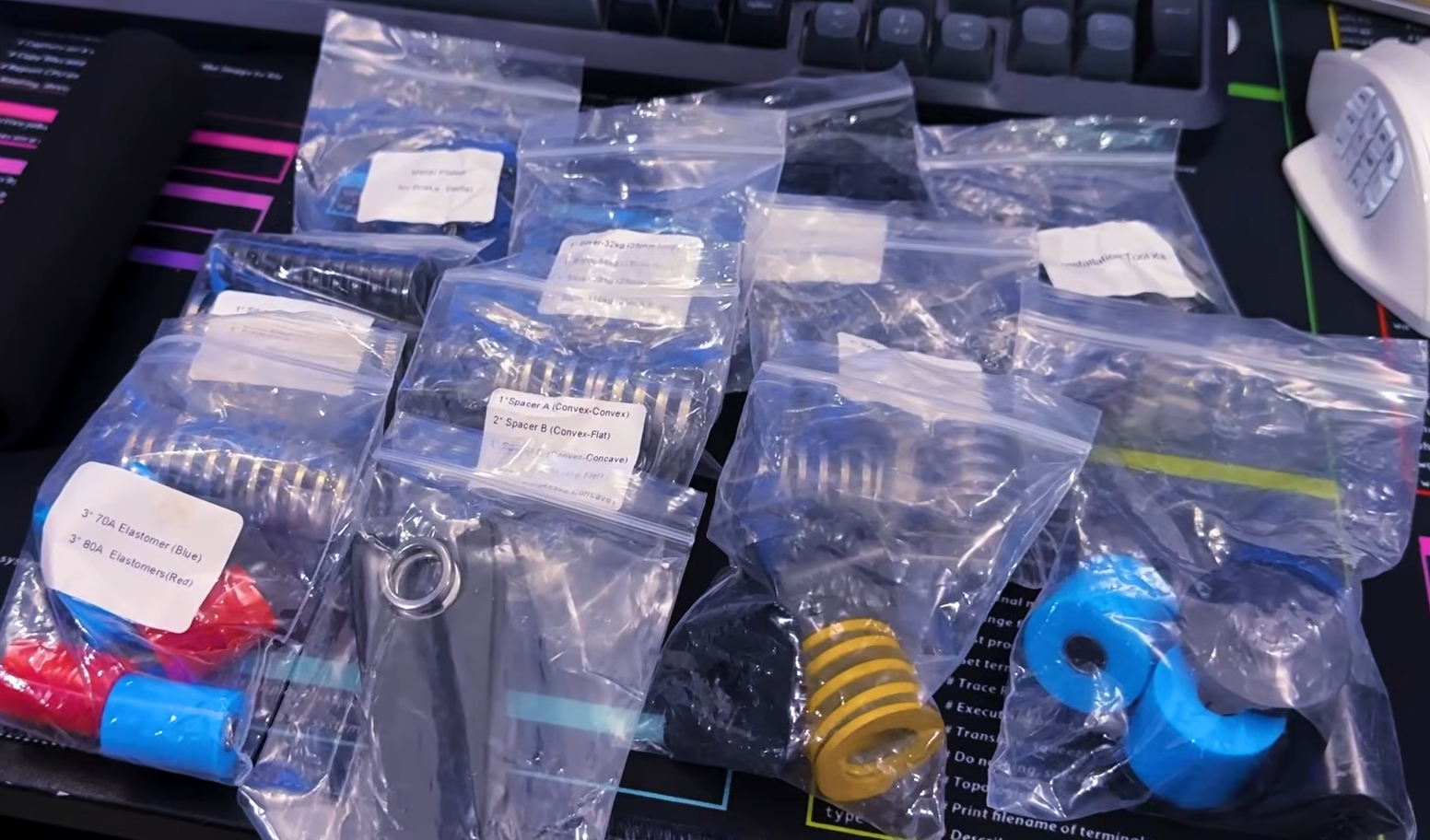
Practically, that means:
- A genuinely massive tuning range: 78 and 8A elastomers, springs in 32, 54, 78, and 116kg weights (two lengths each), plus shaped spacers
- The ability to stack springs on springs, springs with elastomers, or elastomer on elastomer
- Control over preload, so you can dial in when resistance builds, when it falls off, and how the return feels
Dave describes the tuning process less like a horsepower upgrade and more like suspension tuning. It doesn’t change the handbrake’s job. It changes how the handbrake communicates with you.
Two setup notes worth flagging before you buy:
- Once the hydraulic kit is installed, the SHB-100 can no longer be mounted vertically or inverted. The master cylinder has to stay upright, straight from SimNet’s own documentation.
- Certain spring and elastomer combinations get genuinely stiff. Mount this to something rigid, not a flexing rig.
Why the Hydro-Link Sold This SimNet SHB-100 Review
Dave has a useful frame of reference here. He’s tested a range of cheaper sim handbrakes, including the roughly $100 MOZA HPP. He’s also driven a real hydro handbrake in an actual drift car. Once he got the Hydro-Link’s preload and resistance stack dialed in, he says this is the first sim handbrake that genuinely felt like his real on-track car.
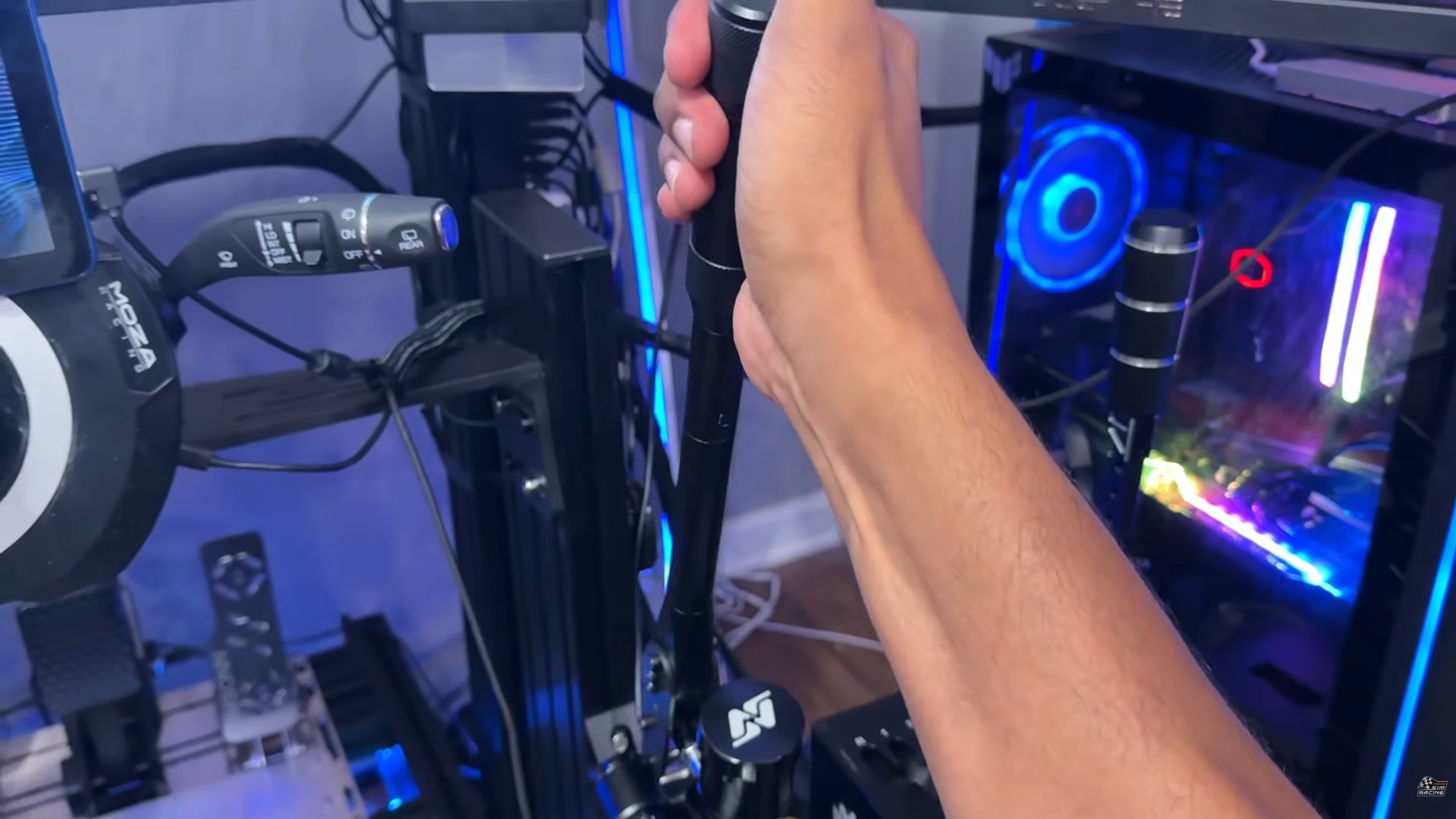
The distinction he draws: a cheap handbrake can deliver a spongy pull with a springy return, and that works fine functionally. The Hydro-Link builds resistance deliberately and mechanically instead. It has a defined ramp in effort and a damped, controlled return that reads as fluid moving through a system, not a spring snapping back.
He’s careful to caveat this too. The SHB-100 isn’t simulating the exact hydro setup of any specific car, since master cylinder sizing, lever ratios, and line compliance all vary by vehicle. What it’s simulating is the feeling of a real hydraulic system, and for Dave, that’s the part that mattered.
Where the tradeoffs are
- Tuning takes real time. Dave’s honest about losing entire evenings to it: change a spacer, run five laps, change an elastomer, run five more, and suddenly it’s 2am.
- You can’t mount it vertically or inverted once the hydraulic kit is installed. Check your rig layout before you buy.
- It doesn’t make you a better or faster driver. This upgrade didn’t unlock new entries or improve car control for Dave. It improved consistency and confidence through better feedback, not raw performance.
- The cost math is steep. The hydraulic kit alone runs $158. That’s more than the handbrake and extension lever combined, roughly doubling the cost of the base setup.
What the full SimNet SHB-100 review setup actually costs
- SHB-100: $129.99
- Soft grip handle: $9.99
- Extension lever: $19.99
- Hydro-Link Pro Kit: $158
All in, the tested configuration lands around $330. Prices can shift month to month, so check current pricing on Sim Motion’s site before deciding. For the full spec sheet, SimNet’s own product page has the breakdown too.
Final Thoughts
This SimNet SHB-100 review keeps coming back to one point: the base unit earns its price on its own. Dave’s clear that the base unit is a legitimately great handbrake at $130. But the Hydro-Link Pro Kit isn’t for most people. Dave says so directly: he wouldn’t recommend it to most sim drifters or rally drivers, not because it underperforms, but because you can get the same core functionality from cheaper options on the market.
Where it earns its keep is with a specific kind of buyer: someone building a no-compromise dream rig, or a training setup meant to mirror a real drift or rally car as closely as possible. For that person, the extra $230 isn’t a gimmick. It’s the difference between a handbrake that works and one that disappears into the experience entirely.
If that’s you, this is likely the most convincing hydraulic handbrake experience on the market right now. If it’s not, you’re not missing anything by staying with a simpler setup, and that’s coming straight from the reviewer, not a marketing line.