

If you’re looking for a sim racing beginner guide that actually makes sense, you’re in the right place. Getting started in sim racing in 2026 can feel overwhelming fast. However, once you understand what actually matters, it becomes much simpler.
This sim racing beginner guide breaks everything down clearly so you know:
- what actually matters
- what you can ignore (for now)
- and how to build a setup that makes sense for you
If you do it right, you don’t just buy gear. Instead, you build a setup that grows with you.
What Sim Racing Is (Beginner Guide Basics)
Sim racing isn’t just another racing game. Instead, it’s built around realism.
Instead, the goal isn’t to “win races” in the traditional sense. It’s to simulate real driving as closely as possible.
For example:
- cars behave based on real physics
- tracks are laser-scanned or highly accurate
- your inputs directly affect grip, balance, and control
That’s why hardware matters so much.
A good setup doesn’t just look cool. More importantly, it helps you:
- feel what the car is doing
- react faster
- drive more consistently
That same principle shows up across all equipment tiers. Better hardware improves immersion, control, and confidence behind the wheel .
What You Need to Start Sim Racing (Beginner Guide)
One of the biggest mistakes beginners make is thinking they need a full rig right away. However, you don’t.
At a minimum, sim racing comes down to three core components.
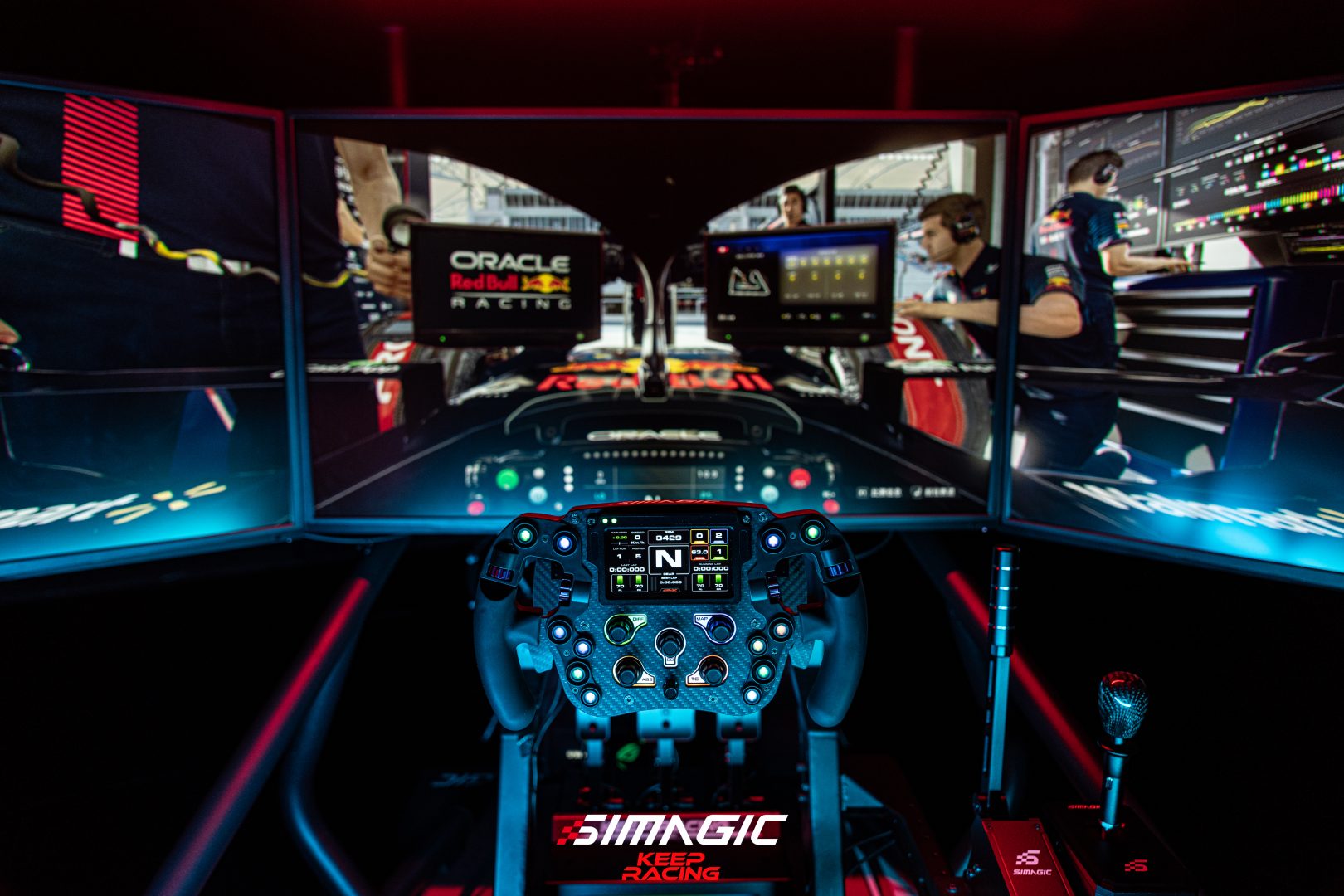
Wheelbase + Steering Wheel
First, this is your connection to the car.
The wheelbase is the motor that creates force feedback. The steering wheel is what you hold.
Together, they determine how much detail you feel from the road, tires, and car behavior. As a result, they directly impact how the car feels. If you’re choosing your first wheel, check out our full breakdown of the best sim racing wheels in 2026.
Pedals
Throttle and brake are essential. Clutch is optional depending on what you drive.
In fact, pedals are more important than most beginners expect. They directly affect consistency, especially braking.
Something to Mount It To
At minimum, this can be:
- a desk
- a table
- or a basic stand
You don’t need a full cockpit yet. Instead, you just need stability.
Everything else like shifters, handbrakes, rigs, and triple monitors is part of your upgrade path. In other words, it’s not your starting point.
Sim Racing Beginner Guide: Why Bundles Are the Best Start
If you want the easiest entry point, bundles are the move. In fact, they’re the simplest way to start.
Instead of figuring out compatibility between:
- wheelbase
- steering wheel
- pedals
As a result, you get everything in one package that’s designed to work together.
That’s why most beginner guides push bundles as the starting point. As a result, you spend less time troubleshooting and more time driving.
Where Sim Motion Fits In
Because of that, Sim Motion’s bundles are built exactly for this.
Entry-Level Direct Drive:
- Moza R3 / R5 bundles
- Accessible pricing with modern direct drive feel
Mid-Range Performance:
- Moza R9
- Simagic Alpha Evo Sport
Pro-Level Setups:
- Moza R21 / R25
- Simagic Alpha Evo Pro / Ultra
If you don’t want to overthink it, start with a bundle.
If you want more control, their custom bundle builder lets you dial in exactly what you want. You can browse all Sim Motion sim racing bundles here to compare entry-level, mid-range, and pro setups.
Sim Racing Setup Budget Tiers (Beginner Guide)
Now, let’s simplify the entire market into three realistic tiers.

Entry-Level ($300–$600)
Here’s what you’re getting:
- Entry-level direct drive bundle (R3 / R5)
- Desk setup
- Basic pedals
More importantly, what it feels like:
- Huge upgrade over controller
- Enough detail to learn fundamentals
This is where you test the hobby. At this stage, you’re just figuring out if it’s for you.
Mid-Range ($800–$1,200) → The Sweet Spot
Here’s what you’re getting:
- Moza R9 or Simagic Alpha Evo Sport
- Stronger, more detailed force feedback
- Better overall build quality
More importantly, what it feels like:
- You can actually feel grip, weight transfer, and road detail
- Driving starts to feel natural instead of forced
This is where sim racing starts to click for most people. As a result, many racers stay in this tier long-term.
High-End ($1,500–$3,000+)
Here’s what you’re getting:
- High torque direct drive (R21 / Alpha Evo Pro / Ultra)
- More advanced pedal setups
- Stronger, cleaner feedback
More importantly, what it feels like:
- More precision and consistency
- Less about “more power,” more about cleaner detail and control
Most importantly:
You don’t need this to be fast.
Higher-end gear gives you refinement, not instant performance gains.
What Matters Most in a Sim Racing Beginner Setup
This is where most beginner guides fall short. Instead of helping you prioritize, they just list specs.
So, here’s the reality:
1. Pedals Matter More Than You Think
Simply put, better pedals = more consistent braking.
And consistency is everything in sim racing. Because of that, pedals matter more than most beginners expect.
Force-based braking (like load cell pedals) builds muscle memory much faster than position-based pedals .
If you stick with sim racing, this is usually your first major upgrade.
2. Stability Changes Everything
In other words, a strong wheel on a weak setup feels worse than a weaker wheel on a stable setup.
If your:
- desk flexes
- pedals slide
- chair moves
You’re fighting your setup instead of learning.
As a result, even small upgrades in stability make a huge difference.
3. Direct Drive Is the New Standard
A few years ago, direct drive was expensive. However, that’s changed.
Now, however, it’s accessible.
That’s why modern beginner guides lean toward direct drive setups even at entry level. You get:
- faster response
- more detail
- smoother feedback
And you won’t outgrow it as quickly .
Best Sim Racing Games for Beginners (2026 Guide)
Start simple. In other words, don’t over-optimize this.
Assetto Corsa
- Huge modding community
- Endless cars and tracks
- Flexible for beginners and advanced users
As a result, this is one of the easiest entry points. Assetto Corsa’s modding community is one of the largest in sim racing.
iRacing
- Structured online racing
- Ranking and safety system
- Highly competitive environment
If you want serious racing long-term, this is where most people end up. iRacing’s official site breaks down how their ranking system works.
Sim Racing Beginner Upgrade Path (What to Upgrade First)
This is one of the most valuable things most beginners miss. However, it makes everything easier.
Sim racing has a very predictable upgrade path:
- Start with a bundle
- Upgrade pedals
- Improve mounting or rig
- Upgrade wheelbase
- Upgrade display (triples or VR)
Because of this, understanding it helps you avoid wasting money.
Instead of buying randomly, you build toward something.
Sim Racing Beginner Mistakes to Avoid
Buying Too Much Too Fast
At first, you don’t know your preferences yet.
Start simple, then upgrade intentionally.
Ignoring Pedals
Most people focus on the wheel. However, pedals matter more.
Pedals are what actually improve consistency.
Chasing Specs Instead of Feel
Torque numbers don’t matter if your setup isn’t stable or tuned well.
Making It More Complicated Than It Needs to Be
Sim racing can be simple. In fact, it should be.
You only need:
- a wheel
- pedals
- something stable
Everything else is optional.
Final Thoughts
Overall, sim racing in 2026 is in the best place it’s ever been.
- Direct drive is accessible
- Bundles make starting easy
- There’s a clear path from beginner to advanced
So, you don’t need the perfect setup.
You just need a good starting point.
Once you have that, everything else builds naturally.