

Inside Sim Racing just dropped a hands-on look at the MOZA CS Pro, and this MOZA CS Pro review does exactly what a good follow-up video should do, especially following our earlier breakdown of MOZA’s 2026 wheel lineup. It slows things down, puts the wheel on a rig, and answers the question a lot of people are asking after CES.

What actually changed with the MOZA CS Pro?
Jake’s review doesn’t chase hype. Instead, it focuses on how the CS Pro feels, how it’s laid out, and where it meaningfully improves on the CS V2 without pretending it’s some radical reinvention.
MOZA CS Pro first impressions and release timing
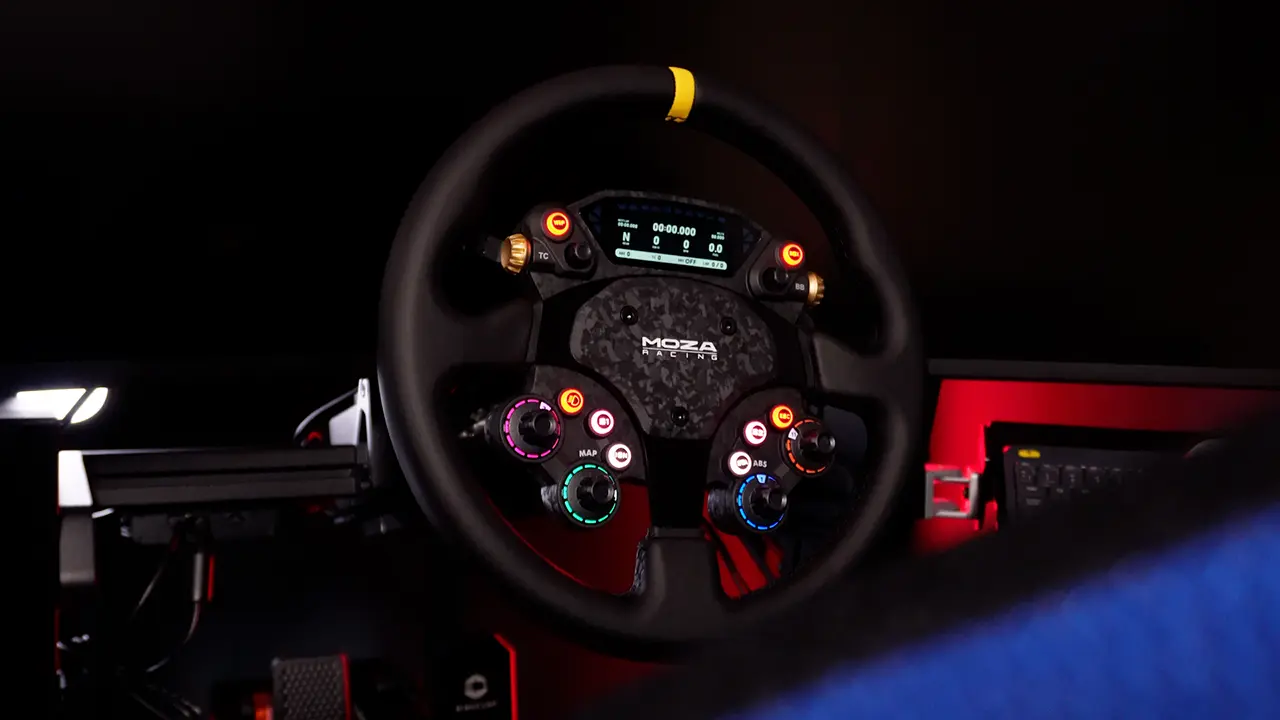
Right out of the gate, Jake confirms timing. The CS Pro launches January 15, with the KS Pro following the next day. From a first-look perspective, the most obvious visual change is the integrated display, which immediately puts the CS Pro in the same conversation as other round wheels that have started adding screens.
The display isn’t treated like a gimmick here. It’s presented as a practical addition that fits the wheel’s role, especially once it’s paired with MOZA’s Pit House software.
MOZA CS Pro materials, feel, and build quality
In hand, the CS Pro keeps the same overall size as the CS V2, but the materials feel improved. Jake specifically calls out the pleather as higher quality, with a better overall feel during driving. The hub also gets subtle visual upgrades, including a carbon-style mesh finish that wasn’t present on the older wheel.
Nothing here feels overdone. The changes aim for refinement rather than flash.
MOZA CS Pro button layout, encoders, and ergonomics
This is where the MOZA CS Pro starts to separate itself.
Compared to the CS V2, the CS Pro adds extra encoders and buttons, including thumb encoders that Jake finds easy to reach, even with larger hands. He notes that the older analogs on the CS V2 felt underwhelming, while the new inputs feel more intentional and better placed.
Button placement gets special praise. Jake repeatedly mentions that everything sits where you expect it, without forcing hand movement or awkward reaches while driving.
Paddles, add-ons, and what you probably don’t need
The CS Pro sticks with familiar paddle and clutch hardware, and Jake doesn’t pretend otherwise. The paddles feel good, but they don’t reinvent anything. MOZA also offers an optional pedal add-on kit for the rear of the hub, priced around $45.
Jake’s take here is refreshingly honest. He questions how many people actually need six paddles and openly says that standard paddles and clutches will cover most use cases. It’s a practical take that lines up with how most drivers actually race.
MOZA CS Pro Pit House software and screen behavior
Once the wheel is on the rig, the screen comes into focus. Jake walks through MOZA Pit House presets, noting that many of the display options lean toward rally-style layouts, which fits the CS Pro’s round-wheel design.
The screen stays subtle. It shows useful information when you want it, but it doesn’t dominate your view or distract while driving. Jake makes it clear that the wheel doesn’t rely on the screen to feel complete.
MOZA CS Pro vs CS V2: the real differences
Side by side, the CS Pro offers more life, more inputs, and better overall usability than the CS V2. Jake highlights the added encoders, improved materials, and rear buttons on the hub as meaningful upgrades, especially compared to what competing wheels have started offering.
He even points out that MOZA added rear hub buttons that some rival wheels skipped, and he calls that a smart design choice for a round wheel.
On-rig driving impressions
On track, the MOZA CS Pro feels solid. Jake runs it on a high-force setup and repeatedly emphasizes that the wheel stays rock solid with no unwanted movement. The pleather feels better than the CS V2 during longer sessions, and the encoders remain easy to reach without shifting grip.
The screen stays readable without becoming intrusive. If you need information, it’s there. If you don’t, it fades into the background.
MOZA CS Pro final verdict and who this wheel makes sense for
Jake’s conclusion stays grounded. The CS Pro isn’t revolutionary, but it is a clear upgrade over the CS V2, especially when viewed alongside our MOZA wheelbase and ecosystem coverage. At $329, it sits in a very competitive spot alongside wheels from Simagic and Conspit.
He’s upfront about personal preference too. If you don’t need a ton of functionality on a round wheel, this might be more than you personally want. But for modern rally, GT4-style cars, and drivers who want flexibility without jumping to a flagship price tier, the CS Pro makes a lot of sense.
If you want to see how those upgrades actually translate on track, the full Inside Sim Racing hands-on video is worth the watch.
It’s not about specs on a page. It’s about how the wheel behaves when you’re actually driving.