

Studio 397, new developers of the ever popular PC sim racing title rFactor2, have published their Stock Car guide part 1. The full-course caution guide serves as a great tool for sim racers that may be new to the art of turning left! In reality, oval racing embodies more than the proverbial left turn, there are complex rules of engagement, as well as differing levels of cautions and terms such as “Lucky Dog” and “Wave Around” for new racers to contend with.
Seeing how rFactor2 simulates all of the key aspects of an oval race, this guide should definitely come in handy for anyone trying their hand at the wildly popular US Stock Car series! We here at ISRTV will post each part of the guide as it is released on the official blog site.
Studio 397 are certainly busy on all fronts right now. With work on DX11 implementation for the title at an advanced stage and VR support looming, 2017 is shaping up to be a great year and a turning point for rFactor2!

Here below is the complete part 1 guide as published on the Studio 397 blog site:
The Full-Course Caution: The basics
Although you might think of a caution in terms of laps behind a safety car (aka the pace car), we decided to break the process down into 10 “phases.” These phases do not necessarily coincide with laps, but important changes take place at every phase. Also, before we get started, there are two very important classifications to understand during a full-course caution: “Lead Lap” and “Lap down” cars:
- A “lead lap” car is a car that does not have any other cars on track ahead of it by +1 full lap.
- A “lap down” car is any car on track that has other cars +1 or +multiple laps ahead of it.
Phase 1 – Yellow flag: Pit lane is closed
A yellow flag is called following an incident somewhere on track, for example after someone has spun their car. Immediately after yellow is called, the pit lane will be closed to all cars on track.
The LSI (Low Speed Information) screen will alert you that pits are closed.
The name is somewhat misleading because you will still be able to enter the pit lane and make a pit stop during “closed pits,” but doing so will result in an end-of-longest-line penalty (EOLL) (see explanation in Phase 9).

Phase 2 – Frozen field
Next, and almost immediately after the yellow drops, the entire field becomes “frozen” – this means all cars should now slow to a reasonable pace and retain the order they are in.
You’ll need to pay attention to the LSI and follow the car you are told to stay behind.

Phase 3 – Safety car joins the field
The safety car will start to slowly make its way out onto the track and attempt to collect the leader behind it. Once it has collected the lead car, the caution laps will start counting, and cars will start to bunch up behind the safety car in “single file.”
Important: Keep a close eye on the LSI screen, it may say “Please Pass the Safety Car.” If you see this message you should promptly pass the safety car and continue to follow behind the driver you are told to stay behind.
Phase 4 – First lap of caution behind the safety car: Pits will open shortly
During most of the first lap behind the safety car pits are still closed, and no cars are allowed to pit without receiving a penalty.
Phase 5 – Lucky Dog: You regain one lap in the standings
The reasons for this rule might not be obvious, but it all goes back to “safety” in real life. The rule prevents cars from racing to the start/finish line in an attempt to regain laps lost after the yellow has dropped. The “Lucky Dog” or “Free Pass” is a reward given to the first car in the order that is one lap (or multiple laps) down at the time the yellow is dropped. If you get the “Lucky Dog,” the LSI screen will alert you.

All you need to do is pull to the left, pass the entire field of cars, pass the safety car, and rejoin the field at the back of the line – and you regain one lap in the standings.

If someone else gets the “Lucky Dog”, you will also be alerted by the LSI screen to allow them to pass.
Important: If you yourself cause the yellow flag and would have received a “Lucky Dog” based on your place in the standings, no one will receive a Lucky Dog in this caution period.
Phase 6 – Second lap of caution: Pits are open to lead lap cars
Depending on the track, shortly before the second lap of caution starts pits will open to all lead lap cars. What does this mean exactly? It means that if any car in the standings is one full lap up on you (+1), then you are not allowed to pit yet.

Important: If you are a lead lap car you must pit in the second lap of caution to move up in the final “re-order” (see explanation in Phase 9).
Phase 7 – Third lap of caution: Pits open to everyone
If you are a lap down car, then you will now be able to pit normally without receiving a penalty. Lead lap cars may also pit.
Important: Although the number of caution laps may vary (4 laps minimum), after lap 2 of caution pits are always open to everyone.
Phase 8 – One lap to go: Double file
During the last lap of caution the LSI will tell you to get into double file formation and will also let you know there’s “one lap to go.”
Make sure to pay attention: You might have to get behind a car you were not behind before.

Phase 9 – Sorting the field just before restart: Final Re-order, Wave-arounds, EOLLs
Just before the race gets restarted, the field must be re-sorted. Three things happen in this very crucial last lap of the caution:
- “Final Re-Order”: Lead Lap cars that pit in lap two move forward, lap down cars move back. If there are “lap down” cars in front of “lead lap” cars, then in this short phase the lap down cars (that pitted in lap two of caution) will be re-sorted behind any lead lap cars. You’ll need to once again keep a close eye on what the LSI is telling you.
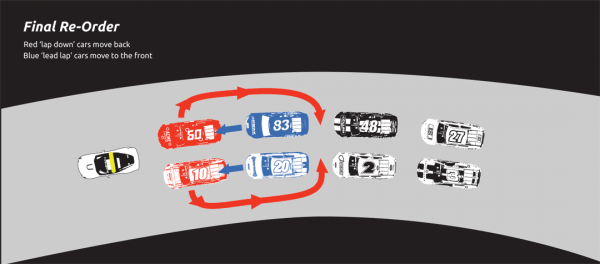
Important: If you were a “lead lap” car and did not pit the 1st lap pits were open, or you pitted multiple times, then you will line up with “lap down” cars and will not get moved in front of them.
- “Wave Around” – getting a “Wave Around” is a good thing! A “Wave Around” simply means you get to pass the safety car and rejoin the field at the back – and you regain a lap! The LSI will prompt you if you have a “Wave Around,” you’ll need to be quick and pass the field and catch up in order to make a good start.

- Important: You get a “Wave Around” if all of the following three conditions are met:
- You are a “lap or laps down”
- You did NOT pit
- You are in front of all of the “lead lap” cars
3 “End of Longest Line” (penalty): You go to the back.

The End-of-Longest-Line or “EOLL” penalty simple means you must pull to the left side, slow down, and fall behind the longest line at the end of the field.

Phase 10 – Restart
Once everything is sorted, and everyone is in double file, the next time around will be restart. The restart happens as follows:
- The safety car will turn in and enter the pits
- Front row lead cars retain pace speed until on the main straight
- The race officially restarts once you hear the spotter announce “GREEN FLAG, GREEN FLAG, GO GO GO!!!”
Important: If you are starting in the front row next to the race leader, make sure that your car is not positioned ahead of the leader when the green flag is called – doing so will result in a “Drive-Through” penalty.
Additional notes on Full-Course Cautions you may find useful:
- Make sure that driver labels (name tags) are always showing during a full-course caution. The default key to show driver labels is TAB.
- You cannot serve “Drive-Through” or “Stop-and-Go” penalties during a caution period. Although you might be instructed to serve them with a message “Warning One Lap To Serve Penalty” you can safely ignore this message during the caution period. However, once the race goes green, you must promptly serve any pending penalties.
- Always follow the driver the LSI screen instructs you to follow, even if you think it is not ordering you properly. The field may still be re-sorting. Ignoring the LSI instructions can lead to a Drive-Through, a Stop-and-Go, an EOLL, or Disqualification.
- During caution periods stay in 3rd or 4th gear to avoid overheating your engine.
- To avoid engine overheating in the pits while making long repairs, make sure to assign keys for “Starter” and “Ignition” beforehand. Important: You will be able to shut off your engine using “Ignition” and restart your engine by pressing “Ignition and Starter” simultaneously.
